AS2, AS4 and ebXML: the digital registered mail your EDI documents travel on
AS2, AS4 and ebXML explained without jargon: how purchase orders and invoices travel between companies, why global retail demands AS2, and when each protocol matters for a Venezuelan business selling to retail chains or exporting.

The most expensive argument in logistics always starts with the same sentence: “that file never reached me.” The purchase order the customer swears they sent. The invoice the supplier swears they emailed. Two serious companies, two versions of the story, and in between: a shipment on hold, a payment frozen, and a business relationship cooling off.
In Venezuela we know that argument well. The order arrives by email, or WhatsApp, or as an Excel attachment. Somebody saw it, somebody didn’t. Somebody rekeyed it wrong. And when things go sideways, there is no way to prove who is right.
Business-to-business commerce solved this decades ago with something that works like registered mail, but digital. It’s called EDI (Electronic Data Interchange: commercial documents traveling computer-to-computer, with no human copying anything), and the “trucks” that carry those documents have names: AS2, AS4 and ebXML.
What are they, in one sentence?
They are transport protocols: agreed rules so a commercial document can travel from one company to another over the internet — encrypted, signed, and with proof of delivery. They are not the document; they are the certified envelope it travels in.
The registered-mail metaphor
Think of how a certified shipment with return receipt works, and you have 90% of the idea:
- Encryption — nobody reads it in transit. The document travels “in a sealed envelope.” Even if someone intercepts it on the internet, all they see is gibberish. Your prices and volumes are never exposed.
- Digital signature — you know who sent it. Every message carries the sender’s electronic signature. Nobody can impersonate your customer to send you a fake order, or later deny sending what they sent.
- The receipt (MDN) — the “received and signed.” When the document arrives, the receiving system automatically returns a proof called an MDN (Message Disposition Notification). It’s the signature on the courier’s clipboard: technical, timestamped evidence that the document arrived complete and intact.
That third point is what kills the “it never reached me” argument. With AS2, nobody can claim non-receipt: either the receipt exists, or it doesn’t. No more word against word.
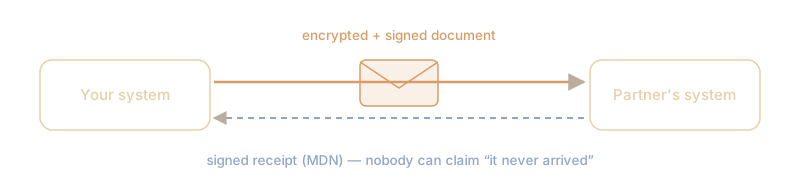
Digital registered mail: encryption, signature and signed receipt
The three names, demystified
| Protocol | What it is | Where it rules |
|---|---|---|
| AS2 | The veteran standard for EDI transport over the internet | Global retail: Walmart made it famous by requiring it from all suppliers since 2002 |
| AS4 | The evolution of AS2 built on modern web services | Europe, governments, energy, structured e-invoicing (the Peppol network) |
| ebXML | The broader e-business framework AS4 grew out of | Conceptual foundation; you’ll rarely see it named in a commercial contract |
AS2 is the one you’ll be asked for first. When a retail chain — in the US, Colombia, Panama — tells a supplier “we need to connect via EDI,” it almost always means AS2. Walmart turned it into a requirement and the rest of retail followed.
AS4 is what you’ll meet if you export to Europe or deal with public entities that require structured electronic invoicing. It does the same job as AS2 (encrypt, sign, acknowledge) on more modern web-service technology.
ebXML is the general framework AS4 came from. Knowing it exists means you won’t panic when it shows up in a technical document: it is not a fourth system to learn.
When does this matter for a Venezuelan company?
- If you want to sell to retail chains (supermarkets, pharmacies, department stores) that already run — or will run — on EDI: the AS2 connection is the toll gate. Without it, your orders keep arriving by email and your invoicing keeps depending on someone rekeying data.
- If you export or plan to: your buyer abroad probably already requires EDI over AS2 (Americas) or AS4 (Europe). Having the capability ready is the difference between closing the deal and staying “under evaluation.”
- If you are a distributor or run a DC (distribution center): every document that enters through WhatsApp today and gets rekeyed by hand is an error waiting its turn. Certified transport eliminates both the rekeying and the argument.
What each side gains
- The sender: proof of delivery for every document, no more resending “just in case.”
- The receiver: documents that flow straight into the system, with no transcription and no transcription errors.
- The relationship: disputes get settled by checking receipts, not by trading blame.
Common myths
- “That’s only for multinationals.” The requirement comes from the big customer, but the connection can belong to an SME. You don’t need an IT department today — you need a partner who operates the connection.
- “We email PDFs, so we’re already digital.” A PDF by email is just faster paper: somebody still has to read it and rekey it. Truly digital is when the document enters the system with no human hands.
- “It’s expensive.” What’s expensive is the alternative: the container on hold, the lost order, the invoice you can’t collect because “it never arrived.”
AS2 and AS4 are the certified envelope; what travels inside — purchase orders, ship notices, invoices — is where the business lives. If you want to see how this connects to your current operation without writing code, take a look at our solutions or get in touch.