B2B dropshipping: how retail sells without touching the box (and why that's an opportunity for your company)
B2B dropshipping explained simply: the retailer sells on its e-commerce site, the supplier ships directly to the end customer, and EDI (850, 856, invoice) makes that choreography work at scale. How it differs from 'Instagram course' dropshipping, and the opportunity for Venezuelan manufacturers and distributors.
Think of the last time you bought something on a big store’s website and the package arrived at your door in a box that wasn’t the store’s. The store sold to you, charged you, and answered for your order — but it never touched the product. The one who packed and shipped it was the manufacturer or the distributor, straight from their warehouse to the customer’s door.
That has a name: B2B dropshipping (business to business). And before you frown: no, this is not the Instagram-course kid reselling things from AliExpress. It is a serious operation between serious companies, with contracts, service levels and — here comes our part — electronic documents that keep the choreography from collapsing.
For a Venezuelan manufacturer or distributor, it’s one of the cheapest ways to multiply your shelf space: your full catalog, displayed on the retail chains’ e-commerce sites, without the chain having to buy your inventory first.
What is it, in one sentence?
B2B dropshipping is an agreement where the retailer sells the product through its channels and the supplier ships it directly to the end customer, without the product ever passing through the retailer’s stores or DC (distribution center).
How it works, step by step
The trick isn’t the idea — it’s making it work a thousand times a day with no phone calls. That’s where EDI comes in (Electronic Data Interchange: commercial documents traveling system-to-system, with no rekeying). The typical choreography:
- The customer buys on the retailer’s e-commerce site. As far as they know, they bought from the store. Period.
- The order (EDI 850) reaches the supplier within seconds, carrying the end customer’s address. Not an email someone will read “in a bit” — a document that flows straight into the supplier’s system.
- The supplier confirms (accepts, or flags an out-of-stock — before the customer finds out the hard way).
- The supplier ships under the retailer’s label: the box, the packing slip and the shipping label all carry the store’s name. The customer never sees the supplier.
- The supplier notifies with the ASN (EDI 856): the electronic ship notice that tells the retailer “it’s on its way, with this tracking number.” With that, the store updates the customer without calling anyone.
- The invoice travels afterwards, electronically, reconciling itself against the order and the shipment.
Notice the psychological detail: the retailer is putting its brand and its reputation in the hands of the supplier’s shipping. That’s why this door doesn’t open for just anyone — it opens for the supplier who can prove, with documents and receipts, that it confirms fast, ships on time and always notifies.
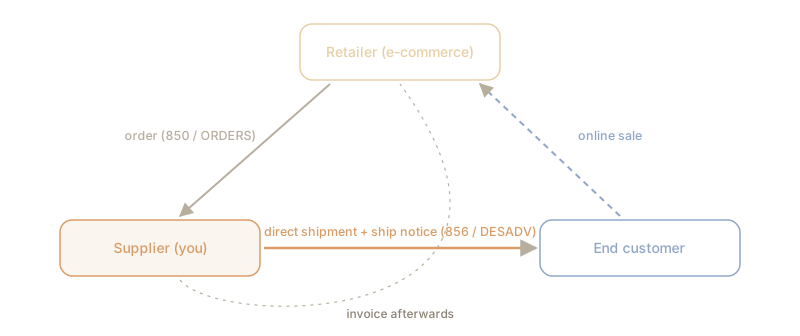
The B2B dropshipping triangle: the retailer sells, you ship, the notice tells the story
What each side gains
- The retailer: an endless catalog with no capital tied up in inventory, no risk of sitting on product that doesn’t move.
- The supplier: access to the retailer’s traffic and brand trust, unit sales with margin (not just full trucks to the DC), and real demand in real time — the best market research there is.
- The end customer: more assortment and, often, faster delivery (the product leaves the supplier’s warehouse, not a saturated DC).
This is NOT Instagram dropshipping
The distinction is worth drawing, because the word got stained:
| “Course” dropshipping | B2B dropshipping |
|---|---|
| Anonymous reseller, generic imported product | Contract between an established retailer and an established supplier |
| No committed stock, no service levels | Reserved stock, agreed and measured shipping times |
| The customer discovers the trick when the package takes 40 days | The customer never notices a thing: box and label in the store’s name |
| Run on spreadsheets and luck | Run on EDI: 850 order, 856 ASN, invoice — everything acknowledged |
The Venezuelan opportunity
The country’s retail chains are investing in e-commerce, and they all hit the same wall: they can’t hold in their DCs everything they’d like to sell online. The manufacturer or distributor who can receive the order electronically, confirm within minutes and ship with notice becomes those chains’ extended warehouse — and gets paid for it.
The entry requirement isn’t owning a truck fleet or an expensive ERP: it’s documented responsiveness. An order that comes in on its own, a confirmation that goes out on its own, an ASN that notifies on its own. Without that, dropshipping gets run on WhatsApp and Excel — and by week three of duplicated orders and unanswered customers, the retailer shuts the tap.
Common mistakes
- Signing the agreement without automating the flow. Ten orders a day can be handled by hand; a hundred cannot. The growth you wanted is what breaks you.
- Not flagging stockouts. The order that gets confirmed and never ships is dropshipping’s cardinal sin: the customer complains to the store, and the store bills it back to you.
- Shipping without an ASN. Without the ship notice, the retailer is blind in front of its own customer. The ASN is not bureaucracy: it’s what the store uses to say “your order is on its way.”
B2B dropshipping is, at its core, selling certainty: the certainty that every order the store hands you will be confirmed, shipped and notified without anyone chasing anyone. If you want to assess what your operation is missing to offer that, check our solutions or let’s talk.