The advance ship notice: the truck that tells you what it's carrying before it arrives
The advance ship notice or ASN (856 in X12, DESADV in EDIFACT) explained without jargon: the truck's contents arrive digitally before the truck does, with a pallet-case-item hierarchy and SSCC labels. Why modern retail demands it and how it transforms receiving at a DC. From the 'EDI without mystery' series.

The truck reached the distribution center at 7 a.m. By 11 it was still at the dock. Why? Because nobody knew exactly what it was carrying: the freight note said “180 packages,” the invoice was in a folder inside the cab, and the receiving crew had to open pallet after pallet, count case by case, and type everything into the system by hand. Four hours of occupied dock, one very annoyed driver — and at the end, two discrepancies against the invoice that nobody can tell apart: counting error or genuine shortage?
Multiply that by the fifteen trucks that DC (distribution center) receives every day and you understand why the big retail chains decided this problem doesn’t get solved by counting faster. It gets solved by making the information travel ahead of the truck.
That is the job of the advance ship notice (X12 calls it an 856, but the transaction exists in every EDI language — full table below).
What is the advance ship notice, in one sentence?
EDI is Electronic Data Interchange: business documents flowing system to system without manual rekeying. The advance ship notice, or ASN, is the document a supplier transmits at the moment of dispatch, describing exactly what’s on the truck and how it’s packed — before the truck arrives.
It’s the packing list, but digital, structured, and early.
The hierarchy: not just what, but how it’s packed
What makes the ship notice special isn’t the product list — it’s that it describes the shipment as a hierarchy of boxes inside boxes:
- Shipment (the truck / the freight note)
- Order (which purchase order it fulfills)
- Pallet (identified by its label)
- Case (the corrugated box)
- Item (product code, quantity, lot, expiry)
- Case (the corrugated box)
- Pallet (identified by its label)
- Order (which purchase order it fulfills)
Every pallet carries a label with a unique code called the SSCC (Serial Shipping Container Code, a GS1 standard — the same organization behind barcodes). That code is the pallet’s ID card, and it’s the bridge between the physical world and the digital notice: the label stuck on the pallet points to the digital detail that already arrived. We explain that label in depth here: SSCC-18, the pallet’s ID.
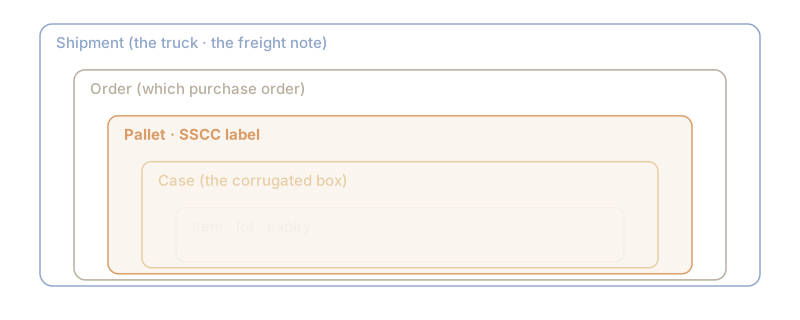
The ship notice hierarchy: boxes inside boxes, down to the lot
What it looks like in practice: consumer goods shipping to a supermarket chain
A consumer-goods supplier ships to the DC of a Venezuelan supermarket chain:
- In its warehouse it builds 26 pallets against the purchase order. Each pallet gets its SSCC label printed and applied.
- When the truck is sealed, its system generates the advance ship notice: shipment → order → 26 pallets → cases → items, with lots and expiry dates. It transmits immediately.
- The DC receives it while the truck is still on the highway. The DC’s system already knows what’s coming, against which order, and can plan the dock and the crew.
- The truck arrives. The receiver scans each pallet’s SSCC label and the system instantly shows its full contents. No opening, no case-by-case counting, no transcribing — just verifying.
- The receiving that took four hours takes forty minutes. Discrepancies, if any, are pinned to a specific pallet — not left as a mystery of “2 packages missing somewhere.”
The bonus: cross-docking
When a DC trusts a supplier’s ASNs, it can do cross-docking: an arriving pallet never goes into storage — it crosses the dock straight onto the truck headed for the stores. That’s only possible when you know what each pallet contains before touching it. Without the ship notice, there is no cross-docking; there is a warehouse.
Why modern retail fines (or refuses) shipments without an ASN
The big chains — increasingly in Venezuela, and for decades everywhere else — require the advance ship notice (856 in X12, DESADV in EDIFACT) as a condition for receiving you, and apply chargebacks when it’s missing, late, or doesn’t match the physical load. It’s not a whim: a truck without an ASN costs them dock hours, counting labor, and inventory errors. Those chains pushed the cost back to whoever creates it. For a supplier, the ASN stopped being “optional technology” and became the price of shelf space.
What each side gains
| Supplier | Buyer (DC) | |
|---|---|---|
| Time | Trucks that unload and turn around fast | Receiving in minutes, not hours |
| Money | Zero compliance chargebacks; fewer disputed invoices | Less counting labor; docks that turn over faster |
| Accuracy | Discrepancies traceable by pallet and lot | Correct inventory from minute one |
| Trust | “Reliable supplier” status (and access to cross-docking) | Can plan before the truck shows up |
Common mistakes
- Sending the notice after the truck already arrived. A notice that doesn’t arrive in advance isn’t a notice; the rule is to transmit at the moment of dispatch.
- The notice says one thing, the pallet carries another. An ASN is worth exactly as much as its accuracy. Generating it from the real scan of the pallet build — not from “what should be on it” — is the difference between trust and fines.
- Printing SSCC labels without connecting them to the document. The label without the notice is a pretty sticker; the notice without labels is a file nobody can check against. They work as a pair.
- Believing it’s only for exports. Any domestic DC receiving volume benefits just the same.
The same document in every EDI language
The advance ship notice is the transaction; “856” is just what one standard calls it. Depending on who you connect with, you’ll find it under these names:
| Standard | Message | Where you’ll see it |
|---|---|---|
| ANSI X12 | 856 (Ship Notice/Manifest, “ASN”) | North America and the Americas |
| UN/EDIFACT | DESADV (Despatch Advice) | Europe, shipping lines, export |
| TRADACOMS | DELHDR/DELDET (Delivery Notification) | Legacy UK retail |
| SAP IDoc | DESADV / DELVRY03-07 (SAP’s internal format: not a company-to-company standard, but it’s what your SAP ERP emits and receives) | Companies running SAP |
| GS1 XML | Despatch Advice | Modern GS1 platforms |
The takeaway: learn the transaction, not the number. If you understand the ship notice — hierarchy, SSCC, advance timing — switching syntax is a mapping exercise, not a fresh start.
Before the truck, the plan
The ship notice announces what’s on the way; its natural companion is the delivery schedule, which announces what will be needed weeks in advance. If your customer is already demanding ASNs and labels — or your DC is still counting cases by hand — see how we solve it in our solutions. The truck may take just as long to get there, but the information doesn’t have to.