EDI for 3PLs: grow without the phone growing with you
How EDI transforms a 3PL's operation: the warehouse transactions explained simply — 940 warehouse shipping order, 945 shipping confirmation, 943 transfer advice, 944 receipt confirmation and 846 inventory status — and why they let you add clients without adding administrative headcount. 'EDI without mystery' series.

The manager of a logistics operator in Valencia signed client number twelve last month. He should be celebrating; instead, he’s hiring. Because the new client arrived with its own format: shipping orders come by email in an Excel file different from the other eleven, stock gets reported on Fridays in yet another template, and questions get settled by phone. Every new client adds boxes moved — and also adds office hours: transcribing, reconciling, answering “how much of product X do I have left?” eight times a day.
That’s the silent trap of the 3PL (third-party logistics provider: the company that stores and ships goods belonging to others): growing in clients means growing in administrative staff, almost in the same proportion. The warehouse scales; the office doesn’t.
EDI (electronic data interchange: business documents that travel system to system, with no manual re-entry) exists to break that proportion. With EDI, client number thirteen arrives speaking the same language as the other twelve — and the phone stops being the information system.
The conversation between the goods’ owner and its 3PL
In a 3PL, the goods belong to someone else: the owner needs to order shipments, announce arrivals and see its stock; the 3PL needs to confirm what it did. That entire conversation fits in five documents. In the X12 standard they carry numbers, but what matters is the concept — learn the transaction, not the number:
- The warehouse shipping order (940). The client orders the 3PL: “ship these products, in these quantities, to this destination, by this date.” It’s the equivalent of the “send this out to so-and-so” phone call — but structured, straight into the warehouse system, no transcription.
- The shipping confirmation (945). The 3PL answers: “shipped: these products, these quantities, on these pallets, with these batches.” And here’s the valuable detail: from that document the client generates its ASN and its invoice automatically — the 3PL ships and the owner’s paperwork builds itself (that notice works like this: the truck that calls ahead).
- The transfer advice (943). The client announces: “goods are on the way to your warehouse” — a replenishment from its plant, an import arriving at the port. The 3PL knows what to expect before the truck shows up.
- The receipt confirmation (944). The 3PL confirms: “received: this arrived complete, this was short, this arrived damaged.” The discrepancy gets documented the same day, with data — not three weeks later in a memory-versus-memory argument.
- The inventory status (846). The 3PL publishes stock on a schedule — nightly, hourly — and the client sees its inventory without calling anyone. The most repeated question in the business (“how much do I have left?”) answers itself.
(In EDIFACT, the international standard, the HANMOV/INVRPT/INSDES family plays these same roles: the syntax changes, the conversation doesn’t.)
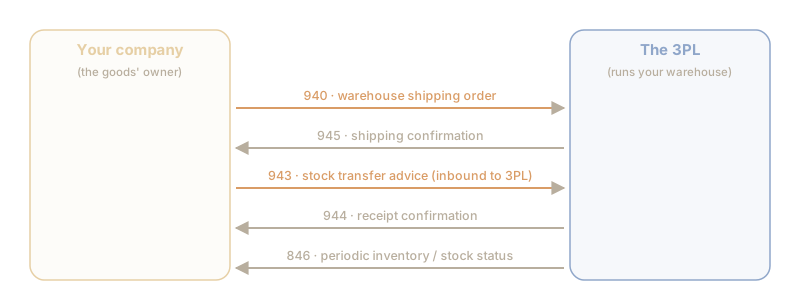
The EDI conversation between the goods’ owner and its 3PL
How it looks in practice
A consumer-goods company outsources its distribution to a 3PL in Guarenas. At 6 a.m., its system sends three shipping orders (940); they land straight in the warehouse system, and picking starts with the first wave without anyone opening an email. As each truck is sealed, the confirmation (945) goes out with pallets and batches: the client invoices and notifies its retail chains without asking a single question. At midnight, the inventory status (846) refreshes the client’s portal. The word “phone” never appeared in this paragraph — that’s the point.
What changes for the 3PL
| Without EDI | With EDI |
|---|---|
| Every new client brings its own format: weeks adapting to emails and Excel | Onboarding in days: the new client speaks the same language as the rest |
| Transcribing orders by hand — and transcription errors land on the 3PL | Zero re-entry: the order goes straight into the warehouse system |
| “How much stock do I have?” by phone, many times a day | The client sees its inventory in real time; trust that renews contracts |
| Shortage disputes: memory versus memory | Every receipt and shipment documented; discrepancies settled with data |
| Growing in volume = growing in administrative payroll | The same office team serves 12 clients or 30 |
And there’s one benefit that doesn’t fit in the table: the door it opens. Large companies — the ones that move real volume — require EDI from their logistics operators as a condition of contract. The 3PL that speaks EDI can say yes to the big client; the one that doesn’t never even makes the shortlist. That’s what growing is all about. We lay out the full economic case for EDI in the cost of not connecting.
Common mistakes
- Connecting only the shipping order. A 940 without the 945 leaves the client blind: it ordered, but doesn’t know what went out. The value is in closing the loop.
- Publishing inventory “whenever possible.” An irregular 846 is worse than none: the client sells against stale stock and the shortage becomes the 3PL’s fault. Fixed frequency, treated as sacred.
- Confirming what should have happened, not what happened. The 945 is only worth its accuracy: it must be generated from the actual shipping scans, not from the original order. This is where labels do the work — the scannable flow rests on the three warehouse labels.
- Accepting “EDI” by email. An Excel attachment that somebody transcribes isn’t EDI — it’s the same phone in a different costume. System to system, or it doesn’t count.
A 3PL sells trust: that someone else’s goods are safe, counted and visible. EDI turns that trust into something the client sees on its screen every day — and frees the office to grow without multiplying. If your operation already feels the phone trap, take a look at our solutions or write to us.