The ROI of EDI: what NOT being connected to your customers and suppliers costs you every month
The cost of not having EDI never shows up on an invoice: it hides in manual re-keying, credit notes, trucks waiting at the dock, and invoices that get paid late. Here's the simple math to calculate it — and decide with numbers, not fear.

Ask any manager what their system costs. They’ll give you the exact number: the license, the hosting, the support. Now ask what it costs them not to be connected to their customers and suppliers. Silence.
That silence is the problem. The cost of not having EDI (electronic data interchange: orders, ship notices and invoices traveling system-to-system, with no hands in between) never appears on an income statement. There’s no line called “manual re-keying” and no ledger account named “the truck that waited four hours.” The cost exists — it’s just scattered across line items with other names, where nobody adds it up.
And what doesn’t get added up doesn’t get budgeted. And what doesn’t get budgeted keeps costing you. Every single month.
What is EDI ROI, in one sentence?
It’s the comparison between what it costs to integrate your systems with your trading partners’ once, versus what it costs to keep moving those same documents by hand forever.
The hidden cost, line by line
This is what you’re already paying today, even if you never see it in one place:
- Manual re-keying. Every order that arrives by email, PDF or WhatsApp and someone copies into the system. International studies put the cost of processing a manual order between $30 and $50, versus under $5 when it travels by EDI. Even if your local cost is lower, the ratio holds: 6 to 10 times more expensive by hand.
- Typing errors. A human copying lines makes mistakes — that’s statistics, not incompetence. Each error becomes something with a name and a cost: the credit note, the return, the shipment that went out at the old price (that’s why the electronic catalog exists).
- The slow dock. Without an electronic ship notice, your truck queues while they count box by box. Driver, fuel, missed appointment — and in modern retail, compliance fines.
- Getting paid late. The invoice with errors isn’t disputed the day it arrives: it’s discovered at month-end, claimed, corrected, re-sent. Every round trip is days of receivables that you finance.
- Expensive people doing cheap work. The analyst who spends the morning “reconciling” orders isn’t serving customers or buying better. You already pay that salary; the question is what that salary buys.
- The sale you never saw. The big customer that requires EDI and quietly drops the supplier who doesn’t have it won’t even call to let you know. This is the most expensive hidden cost: it doesn’t even leave a trace.
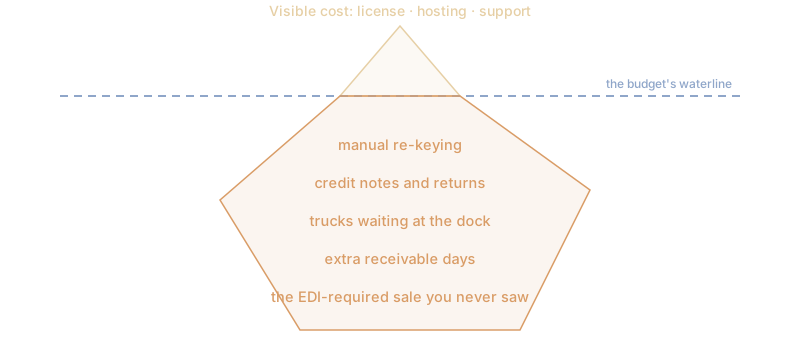
The cost iceberg: what gets budgeted floats; what hurts sits below
The simple math (run your own)
A mid-sized distributor, conservative numbers:
| Item | Calculation | Per year |
|---|---|---|
| Re-keying 600 orders/month | 15 min each = 150 h/month of an analyst | ~1,800 hours |
| Errors (2% of orders) | 12 credit notes/month × admin and shipping cost | 144 incidents |
| Trucks waiting | 4 deliveries/week × 2 extra dock hours | ~400 fleet hours |
| Extra receivable days | 5 days on monthly invoicing | financing you provide |
Put your own rates on that table and compare it against the cost of an integration that’s implemented once and goes live in weeks, not years. In most cases we’ve seen, break-even arrives in months. Everything after that is recovered margin.
The three myths that cost real money
- “EDI is for multinationals.” True in the ’90s, when it required costly VANs and dedicated consultants. Today the connection runs over the internet, and modern protocols put it within reach of a mid-sized distributor.
- “My ERP can’t do it.” Your ERP doesn’t have to: that’s what the integration layer is for. The ERP keeps doing its job; EDI translates.
- “My customer doesn’t require it yet.” The dangerous word is yet. When the chain requires it, it will come with a deadline and a penalty — and you’ll implement in a rush what you could have implemented with a plan.
The conclusion that fits in one line
Not having EDI is also a financial decision. It’s just the only one that renews itself every month, with nobody’s signature.
If you want to put numbers on your own table — with your volumes and your rates — let’s talk: in one short call we’ll help you calculate your operation’s hidden cost and see which piece to connect first.