FideX (AS5): the future of certified EDI transmissions
What FideX (AS5) is, explained simply: the proposed next generation of digital registered mail — from AS2 and AS4 to REST + JSON — with signatures for non-repudiation, end-to-end encryption and a signed J-MDN receipt via webhook. What the draft proposes, its current status, and why it matters to a Latin American SME.
In the digital registered mail article we told how AS2 and AS4 killed the most expensive argument in logistics: “that file never reached me.” Encryption, signature, proof of delivery. Problem solved… for whoever can afford it.
Because that’s the part we didn’t tell: setting up AS2 is still a small ordeal. Certificates exchanged by email that expire without warning, specialized software from the 2000s, technologies (S/MIME — and in AS4, SOAP) that no developer under forty has ever touched. For a multinational, it’s paperwork; for a mid-size distributor in Valencia or Barquisimeto, it’s a wall. And twenty-year-old walls are exactly the kind of thing the internet eventually tears down.
Today we introduce the candidate to tear it down: FideX, also known as AS5.
What is FideX, in one sentence?
FideX (Fast Integration for Digital Enterprises eXchange) is a proposed specification for the next generation of certified B2B document transport: the same guarantees as AS2 — nobody reads it in transit, you know who sent it, nobody can deny receiving it — but built on the technologies every web developer uses today: REST, JSON and HTTPS.
Transparency first: FideX is a draft (version 1.0, February 2026), driven by a working group in which the Greicodex/Kontext team participates in its design. It is an open proposal, not a standard ratified by an international body. We tell you this plainly because this blog is called “EDI without mystery” — and the mystery includes not dressing proposals up as accomplished facts.
The genealogy: why “AS5”
The “AS” (Applicability Statement) family is the digital registered mail family, and each generation was rewritten in the technology of its era:
| AS2 (2005) | AS4 (2013) | FideX / AS5 (2026, draft) | |
|---|---|---|---|
| Technical base | MIME/S-MIME over HTTP (RFC 4130) | SOAP + WS-Security (OASIS ebMS 3.0) | REST + JSON + JOSE over HTTPS |
| The receipt | MDN (email-style) | ebMS Receipt | J-MDN: signed JSON, via webhook |
| Key exchange | Manual, by email | Manual | Automatic discovery |
| Who can operate it? | EDI specialists | Integration specialists | Any web developer |
| Learning curve | Weeks | Weeks | Hours |
AS2 speaks the language of 1990s email. AS4 speaks the language of 2000s corporate web services. FideX speaks the language today’s systems are built in: the same REST + JSON as any payment gateway or banking API.
What the draft proposes (the essentials)
- A two-part JSON envelope. Every message carries a cleartext
routing_header— sender, receiver, document type, timestamp: what the “mail carrier” needs for routing — and anencrypted_payload: the commercial document, encrypted. The carrier reads the label; never the letter. - Sign first, then encrypt. The document is digitally signed (that gives non-repudiation: the sender cannot deny sending it) and then encrypted (that gives confidentiality: only the addressee can open it). In technical shorthand: JWE(JWS), using JOSE — the JSON signing-and-encryption standard that already protects millions of logins every day.
- The J-MDN: the modern “received and signed.” When the message arrives and verifies, the receiving node sends back — asynchronously, to the sender’s webhook — a JSON receipt signed by the receiver, carrying the original message’s digital fingerprint. It is the direct grandchild of AS2’s MDN: technical proof of delivery, with signature and timestamp.
- GLN addressing. Each company is identified by its GLN (Global Location Number, from GS1 — the same family as the SSCC), as a URN:
urn:gln:0614141000012. A company ID card, global and unambiguous. - Payload-agnostic. FideX doesn’t care which language travels inside the envelope: it can be X12, EDIFACT or GS1 XML. The envelope changes; the letter doesn’t.
- Partners that connect in minutes. Instead of AS2’s manual certificate exchange, the draft defines automatic discovery: each node publishes its configuration and public keys at standard URLs, and registering a partner can be as simple as scanning a QR code.
The sentence that sums up the proposal: if you can call an API, you can use FideX. No S/MIME, no SOAP, no archaeological software.
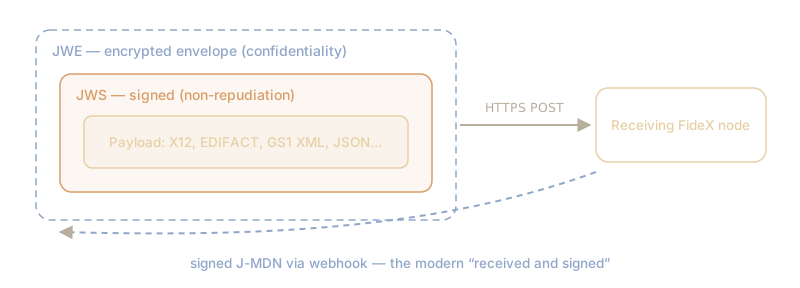
FideX (AS5): sign, encrypt, send over HTTPS — and the J-MDN receipt returns via webhook
The Latin American angle
Think about who was locked out of certified EDI for twenty years: the mid-size distributor, the regional manufacturer, the pharmacy with ten branches. Not because they didn’t need it — “it never arrived” costs them just like it costs Walmart — but because the toll was the VANs (private value-added networks that charge per document) or an AS2 infrastructure with its own specialist attached. FideX’s promise is that the registered-mail guarantee runs on what that company already has: HTTPS, a web developer and any ordinary server. Certified EDI without the club membership fee.
Honesty about the present
- Can I use it with my retail chain today? Not yet: no chain requires it, because it’s a draft. B2B specifications get adopted when the big buyers demand them — that’s how it went with AS2 and Walmart in 2002.
- Then why should I care? Because standards are cooked years before they’re served, and whoever understands the menu early decides better. Besides, as TRADACOMS taught us, the old stuff doesn’t vanish: AS2 will coexist with whatever comes next for decades.
- And what does Kontext get out of telling me this? We participate in FideX’s design, and we say so without hedging. Our bet is the same one behind this whole series: that EDI stops being a closed club. An open, auditable standard — no black boxes — is the protocol version of that bet.
The certified envelope is being reinvented in the language of the web, and this time the entrance is the size of an API. If you want your operation ready to speak with today’s EDI — and tomorrow’s — take a look at our solutions or get in touch.