The three warehouse labels: GTIN-13, GTIN-14 and SSCC-18 explained simply
The GS1 identification hierarchy without the jargon: the unit's GTIN-13 (the checkout barcode), the corrugated case's GTIN-14, and the pallet's SSCC-18. Why every packaging level carries its own ID and how that transforms inventory, shrinkage, shipping and receiving in the warehouse. 'EDI without mystery' series.

It’s month-end and inventory count time at the warehouse in Guarenas. The supervisor opens a corrugated case to check which product it is, counts the units, writes it on a sheet, and moves to the next one. When the count closes, the sheet says one thing, the system says another, and nobody knows whether the difference is real shrinkage, a counting error, or a case that shipped without being recorded. The count took three days. Confidence in the number: zero.
Now look at a warehouse where nobody opens anything. The forklift driver scans the pallet label and the system tells him what’s inside. The picker scans a case and the system knows it’s “the 24-unit case of 400 ml shampoo.” The store cashier scans the unit and rings it up. Three packaging levels, three labels, zero opened boxes.
That’s the secret: every packaging level carries its own ID card. And because everything that moves has an identity, the warehouse never has to open anything to know what it is.
What are the three labels, in one sentence?
GS1 is the global organization that manages barcodes (the same one behind the code every checkout scans). Its identification system works in levels, like nesting dolls:
- The unit — GTIN-13 (the familiar EAN/UPC). The GTIN (Global Trade Item Number) is the 13-digit code printed on the product’s packaging: the shampoo, the flour, the toothpaste. It’s what the checkout scans. It identifies the type of product the consumer buys.
- The case — GTIN-14 (the corrugated code). It takes the unit’s GTIN and prepends an indicator digit that signals the packaging level. The result: a distinct code that means “the 24-unit case of that shampoo.” Whoever scans it knows what’s inside and how many units it holds — without opening the case.
- The pallet — SSCC-18 (the pallet’s ID card). Unlike the other two, it doesn’t identify a product type but that specific pallet: a unique 18-digit serial that never repeats anywhere in the world. It’s the one that connects the physical world to electronic notices. We cover it in depth here: SSCC-18, the pallet’s ID.
Note the nuance: GTIN-13 and GTIN-14 say “what this is”; SSCC-18 says “which one this is.” The first two are like a car’s model; the last one is like its license plate.
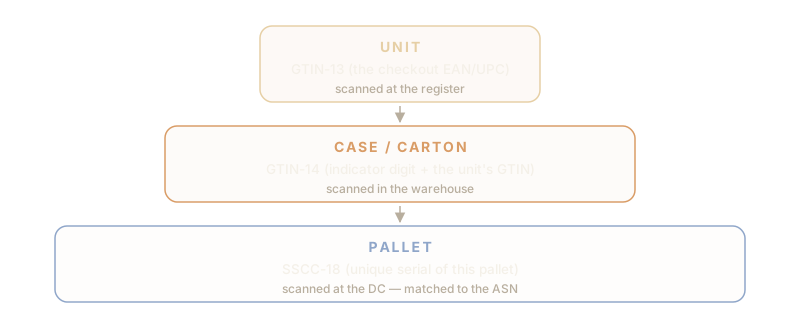
The GS1 label hierarchy: unit, case and pallet — every level carries its ID
How it looks in practice
A consumer-goods distributor in Valencia receives pallets from the manufacturer, each labeled with an SSCC. Each pallet carries 80 cases with their GTIN-14 printed on them, and each case holds 24 units with their GTIN-13. When the distributor picks an order for a pharmacy chain, the picker scans full cases (GTIN-14), and if the order calls for loose units, opens one case and scans units (GTIN-13). When the outbound pallet is built, the system generates a brand-new SSCC for it. At no point did anyone eyeball a count or type a code by hand.
What the warehouse gains, section by section
- Inventory. Cycle counts happen by scanning, not by opening: sealed pallet = one SSCC scan; sealed case = one GTIN-14 scan. A count that took days takes hours, and inventory accuracy climbs above 99% — because the data goes from scanner to system without passing through a paper sheet.
- Shrinkage. What gets identified gets tracked; what never gets scanned “disappears.” When every movement is recorded by code, shrinkage stops being a month-end mystery and becomes concrete events: this case went out, this pallet came in, this unit was damaged. Internal theft and sloppiness love paper; the scanner gives them away.
- Shipping. Scan-validated picking makes the wrong case beep before it gets on the truck: the system expects product A’s GTIN-14 and the picker scanned B’s — error caught at the dock, not in the customer’s complaint. Fewer returns, fewer credit notes, fewer “you sent me the wrong thing.”
- Receiving. Receiving by scanning instead of counting by hand: a pallet arriving with an SSCC gets matched against the electronic ship notice, and a receiving job of hours becomes minutes. How that match works is the story of the truck that calls ahead.
- Transfers between warehouses and branches. Goods travel with an identity: the pallet that leaves Valencia with its SSCC is the same one that arrives in Barquisimeto. Nothing gets lost “along the way,” because the way itself was recorded scan by scan — and any discrepancy can be pinned to a specific leg, not to a shrug.
The same benefit at every level
| Level | Code | What it identifies | Who scans it |
|---|---|---|---|
| Unit | GTIN-13 (EAN/UPC) | The consumer product type | The checkout |
| Case / corrugated | GTIN-14 (indicator + GTIN) | “The case of 24” of that product | The warehouse picker and receiver |
| Pallet | SSCC-18 | That specific pallet (unique serial) | The forklift driver and the DC dock |
Common mistakes
- Scanning the unit for everything. Opening the case to scan the GTIN-13 inside throws away half the benefit: the GTIN-14 exists precisely so you don’t open it.
- Using the same code for the unit and the case. They are different items with different codes; if they share one, the system can’t tell whether 1 unit came in or 24 did.
- Made-up internal codes. A “homemade” code works inside your own building, but it’s useless the day a customer or supplier requires the standard. GTINs come from the prefix GS1 assigns to your company.
- Labels that won’t scan. Faded print, a wrinkled label, or a label wrapped around the case’s corner: if the scanner fails, the operator goes back to typing by hand — and the errors come right back with him.
The three labels are the physical part; the full value shows up when they connect to the electronic documents flowing between companies. If your warehouse still counts by hand, or a customer is already demanding standard labels, see how we solve it in our solutions or write to us.